
News
New Dragonfly Species Discovered in Kerala: Lyriothemis abrahami

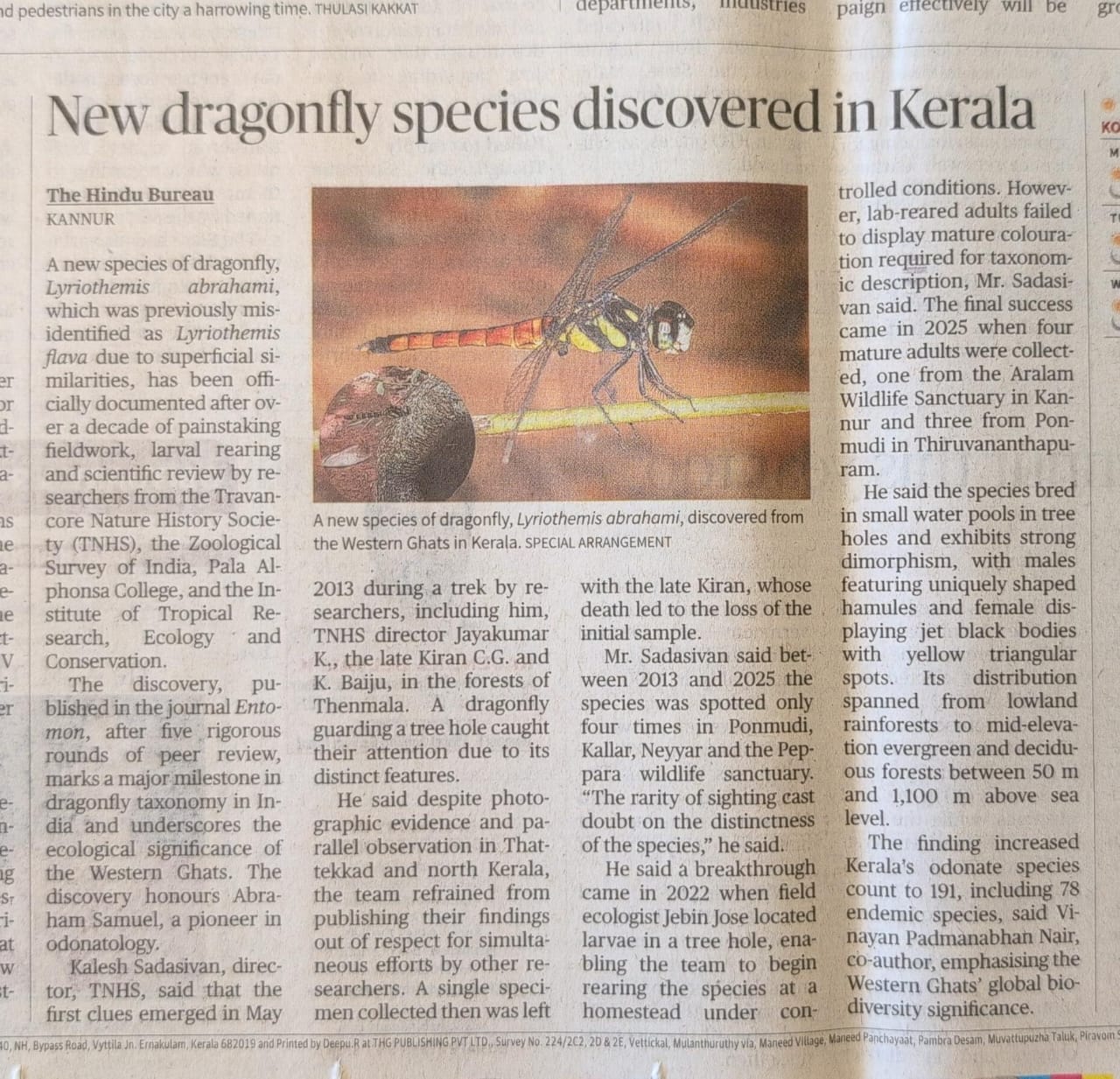
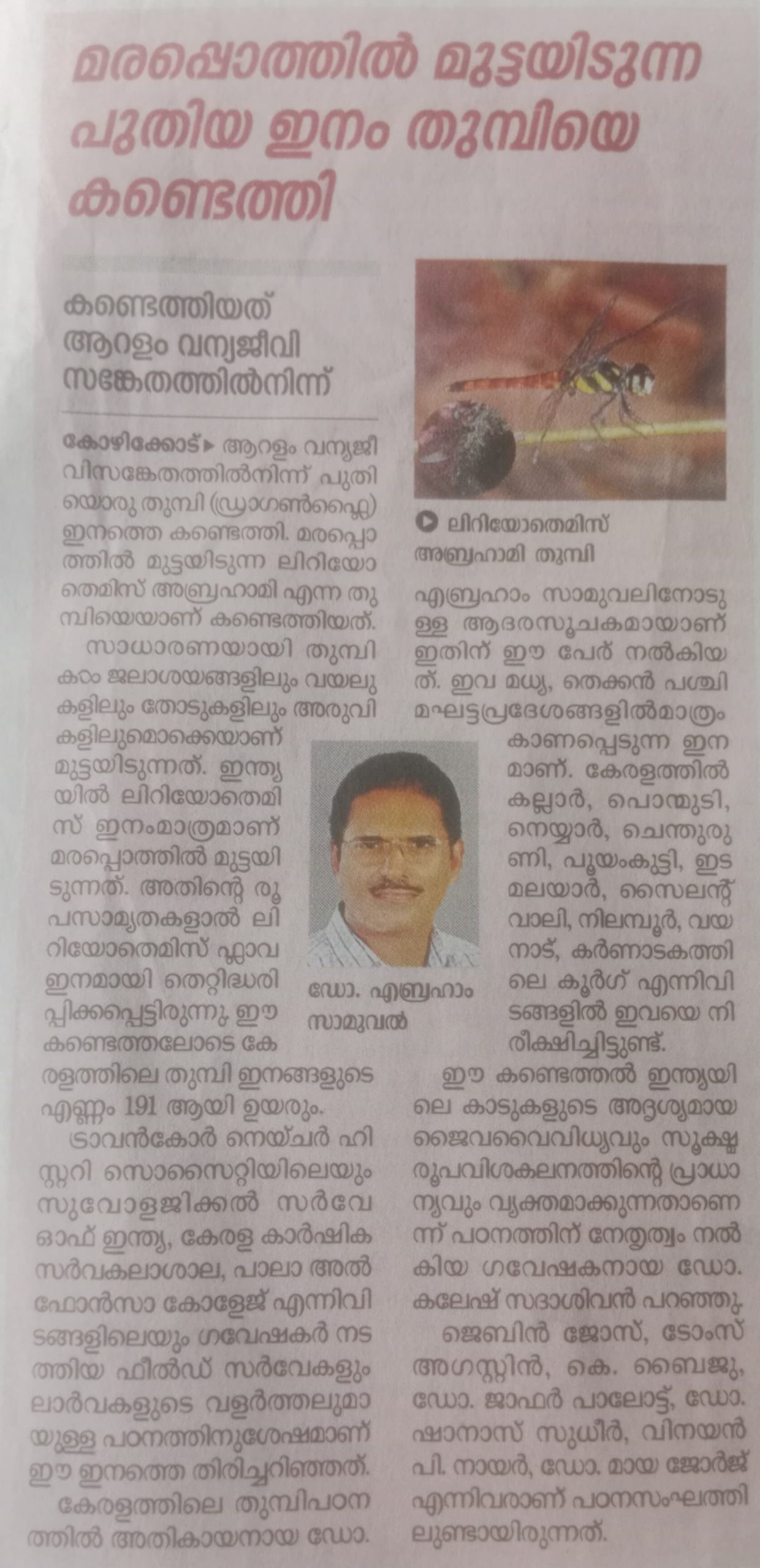
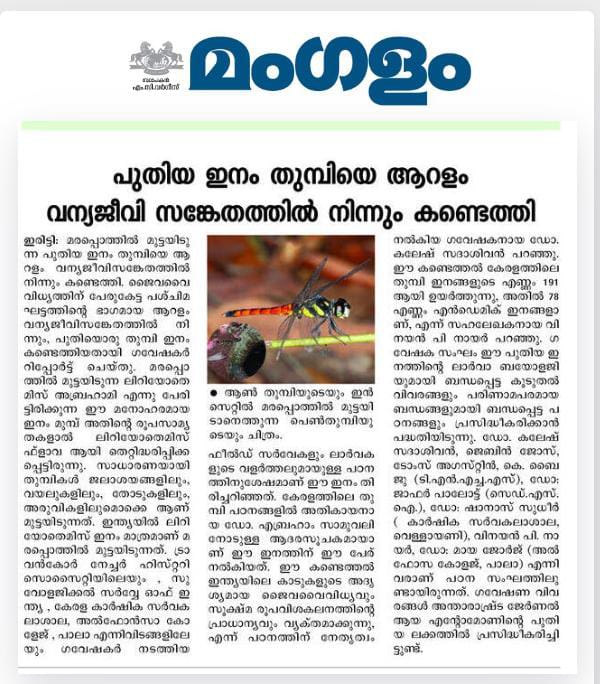
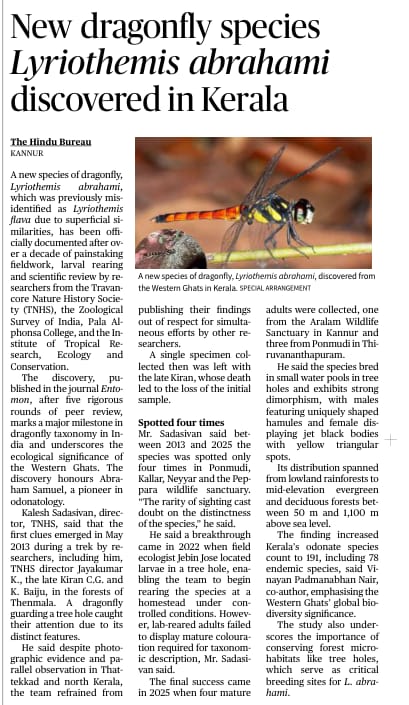
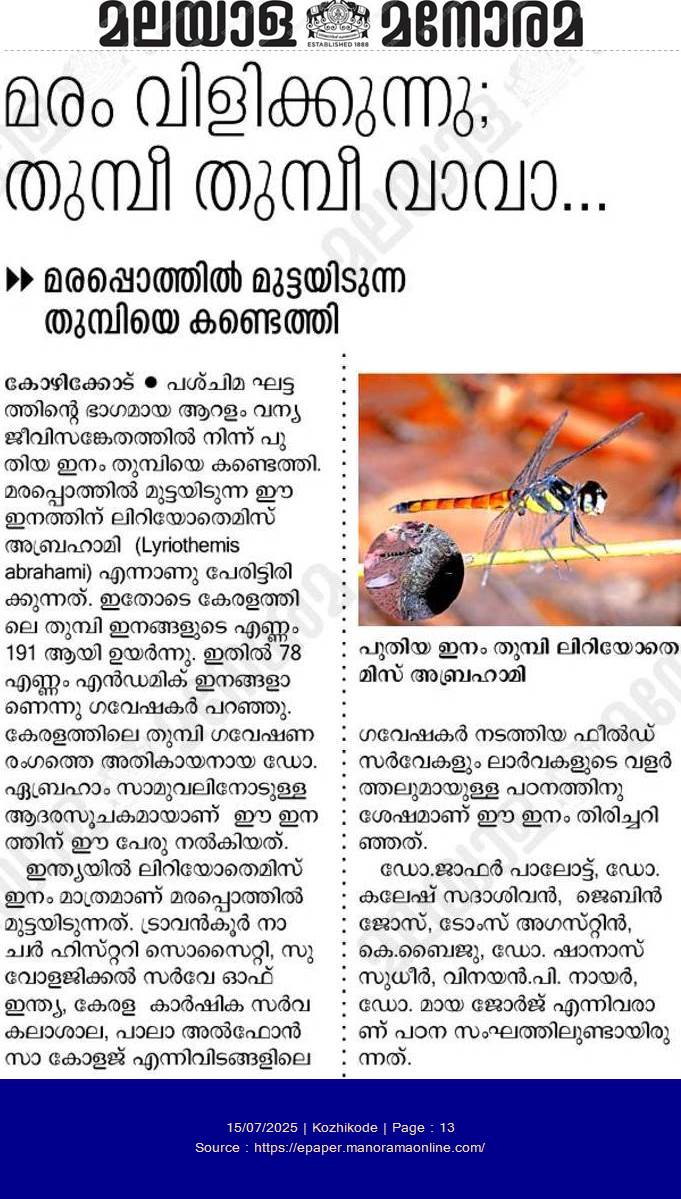
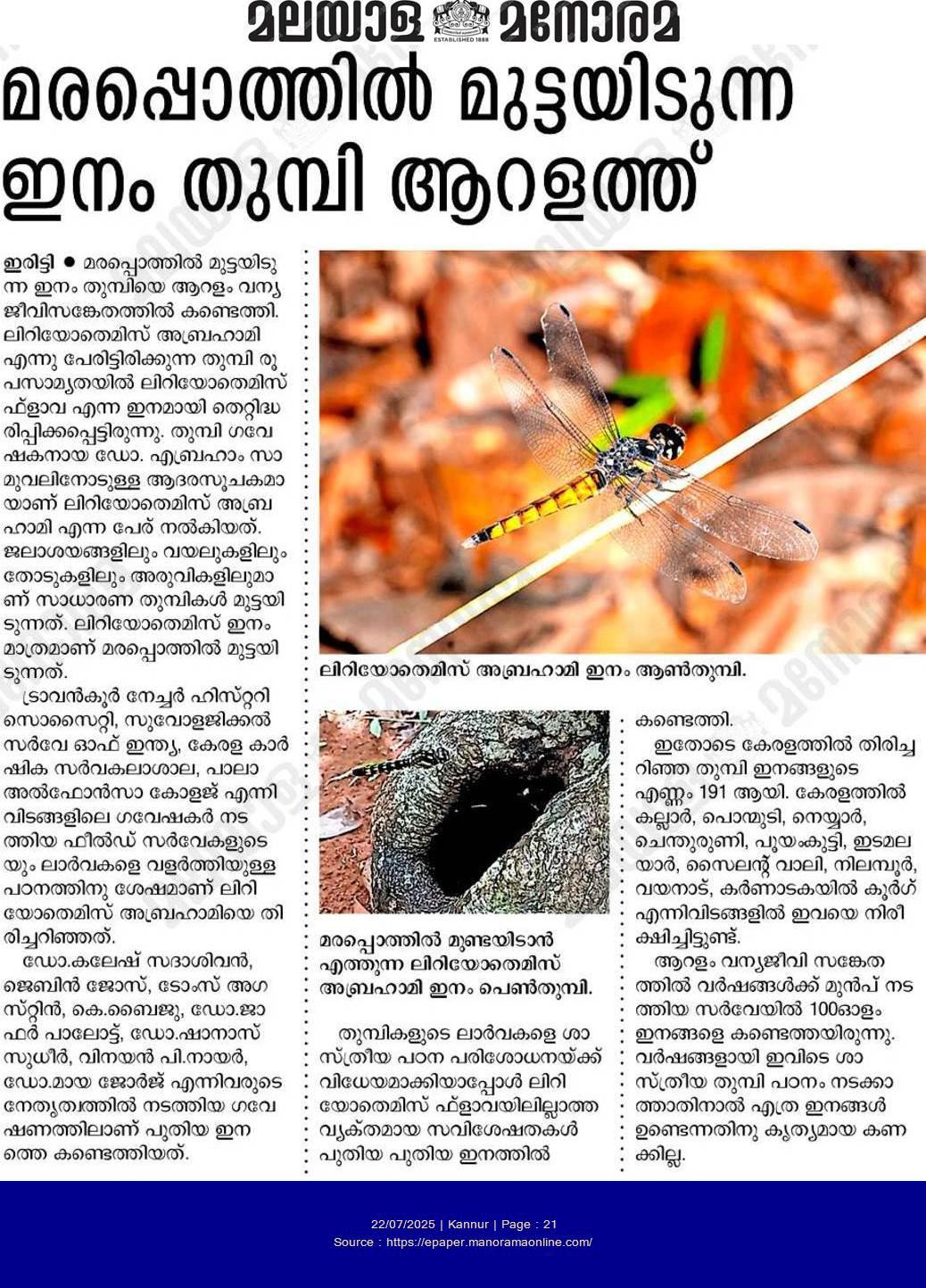
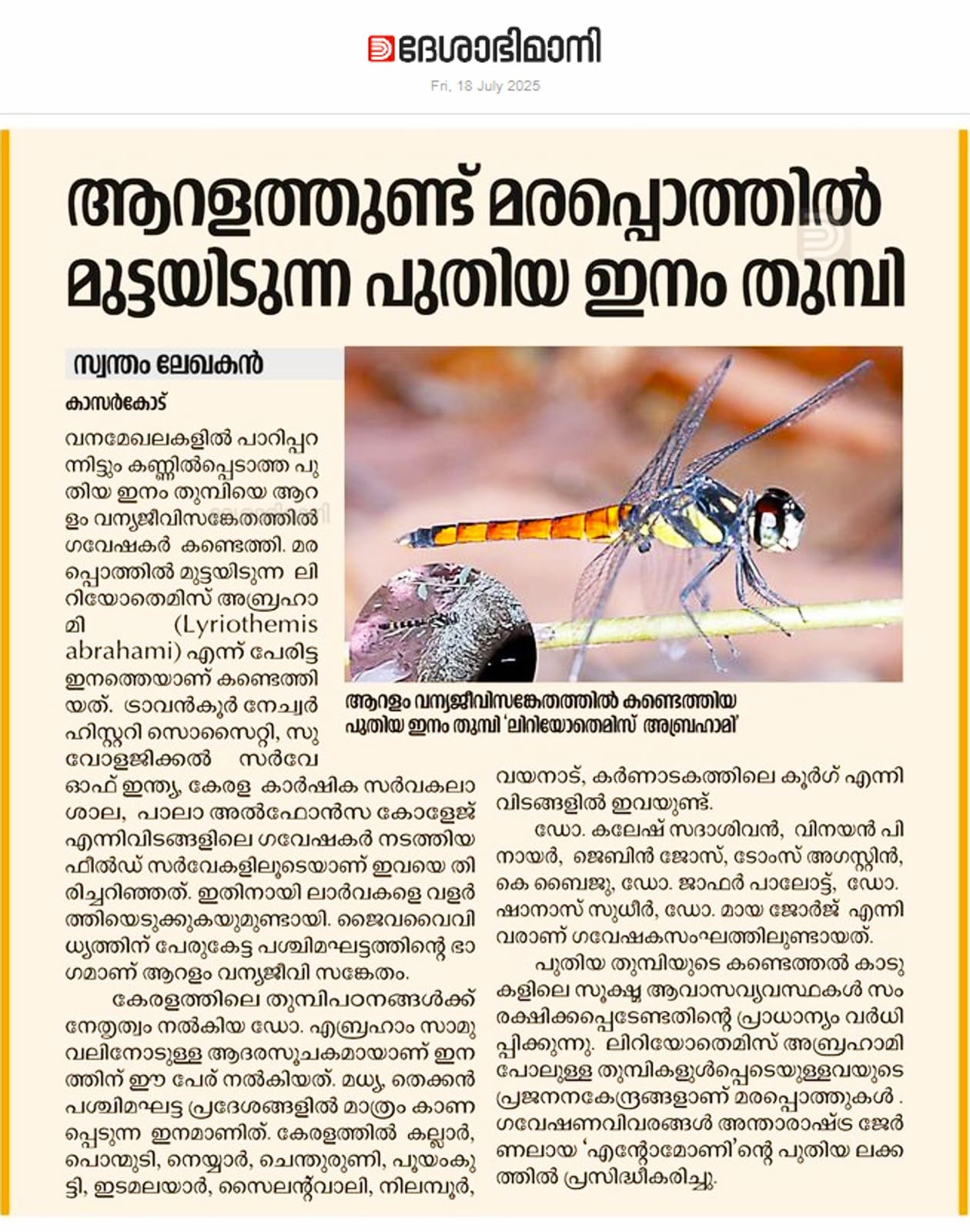
Thiruvananthapuram, July 2025 — A new species of dragonfly has been discovered in the Western Ghats of Peninsular India, a region renowned for its biodiversity. This striking species, named Lyriothemis abrahami, was previously misidentified as Lyriothemis flava due to superficial similarities. The discovery was made by researchers from the Travancore Nature History Society (TNHS) and collaborating institutions following field surveys and larval rearing experiments. The species is named in honor of Dr. Abraham Samuel, a pioneer in odonatology from Kerala. It is endemic to the southern and central Western Ghats and has been found in multiple forest landscapes in Kerala and Karnataka.
“This discovery highlights the hidden diversity within India's forests and the value of close morphological study,” said Dr. Kalesh Sadasivan, lead author and odonate researcher of TNHS. “Our rearing of larvae and dissection of adults revealed distinct characters not found in L. flava.”
The new species breeds in phytotelmata, which are small pools of water in tree holes, and exhibits strong sexual dimorphism. Males possess uniquely shaped hamules, whereas females are jet-black with prominent yellow triangular spots. Its distribution ranges from lowland rainforests to mid-elevation evergreen and deciduous forests (50–1100 m ASL), yet it remains rare and localized. The findings have been published on June 30th in the esteemed journal Entomon.
“Lyriothemis abrahami exemplifies how species can be overlooked when relying on superficial characters or juvenile forms,” noted Dr. Muhamed Jafer Palot of the Zoological Survey of India. “It was misidentified for over a decade due to similarities with L. flava.”
The study revealed that specimens from earlier reports, including a female collected in 2013, belonged to this new species. The research team conducted comparative analyses with historical material and illustrated the diagnostic traits.
“The discovery raises Kerala’s odonate count to 191 species, including 78 endemics,” said Vinayan Padmanabhan Nair, co-author. “It emphasises the Western Ghats’ role as a global biodiversity hotspot.”
This discovery reinforces the importance of conserving forest microhabitats. Tree holes, often overlooked, are critical breeding sites for species such as L. abrahami. The loss of mature trees and canopy cover threatens these delicate niches.
“This dragonfly is not just a species — it's an indicator of forest health,” said Jebine Jose, co-author and field ecologist. “Conserving its habitat helps protect many other unseen organisms.”
The team plans to publish further findings on the larval biology and evolutionary relationships of this new species. Their integrated approach, which combines field biology, taxonomy, and re-examination of records, demonstrates the continued value of natural history studies.